How to Style a Console Table — The Complete Guide
A console table is one of the hardest pieces of furniture to style. Too much stuff and it looks cluttered. Too little and it looks bare. Get the balance wrong and the whole entryway feels off.
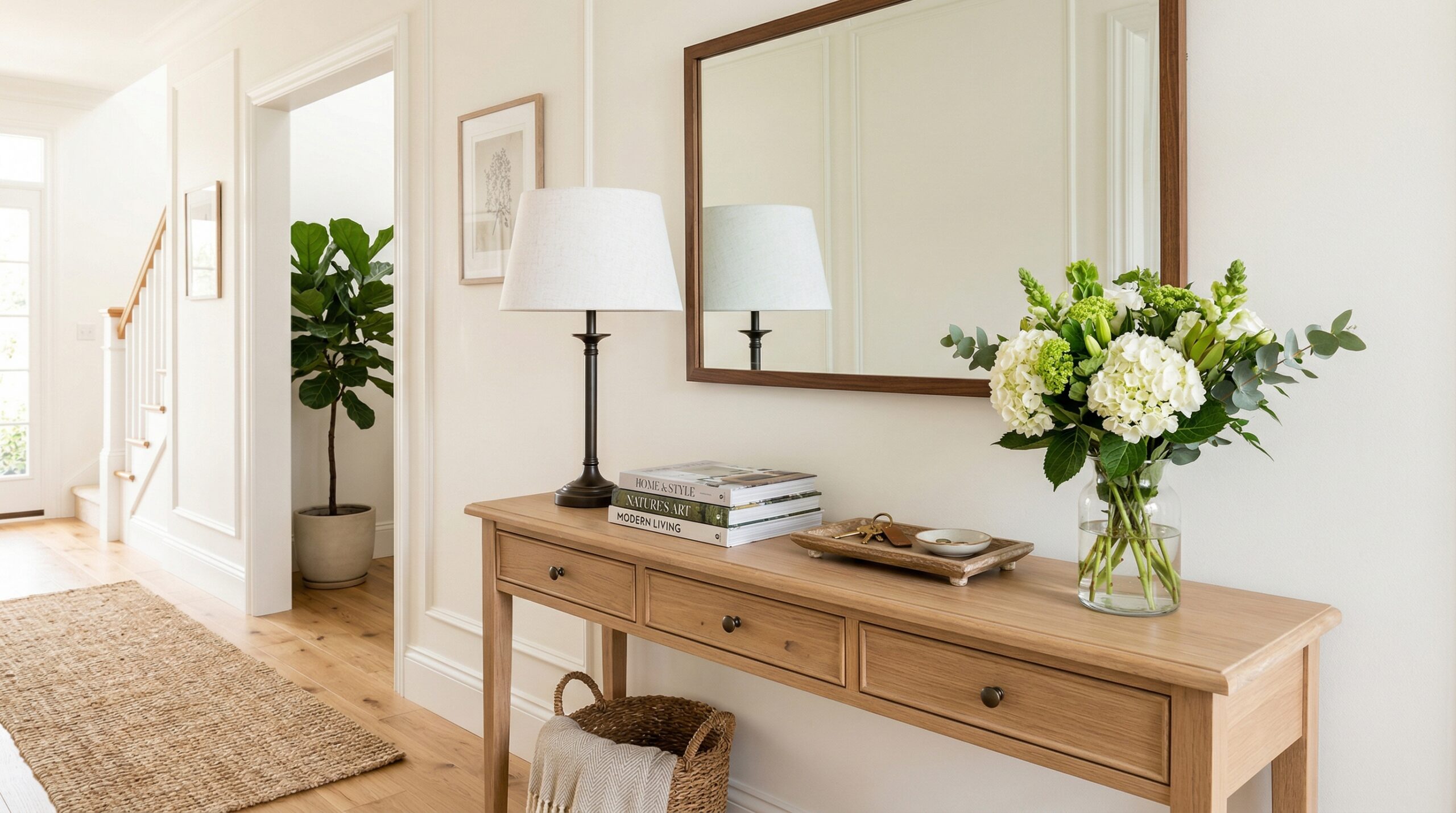
But when you get it right? A well-styled console table becomes the focal point of your entryway — the first thing guests notice when they walk in.
Here’s how to style a console table that actually looks intentional.
START WITH THE RIGHT TABLE
Before you style anything, make sure your console table fits the space.
Console table sizing:
- Standard height: 30-36 inches (same as dining table height)
- Standard depth: 12-18 inches (narrow enough to not block walkways)
- Length: Should be proportional to the wall — aim for 2/3 the width of the wall space
Placement rules:
- Leave at least 3 feet of clearance for walking
- Center the table on the wall (unless you’re going for an asymmetrical look)
- If placing under a mirror or art, the table should be narrower than the piece above it
THE RULE OF THIRDS
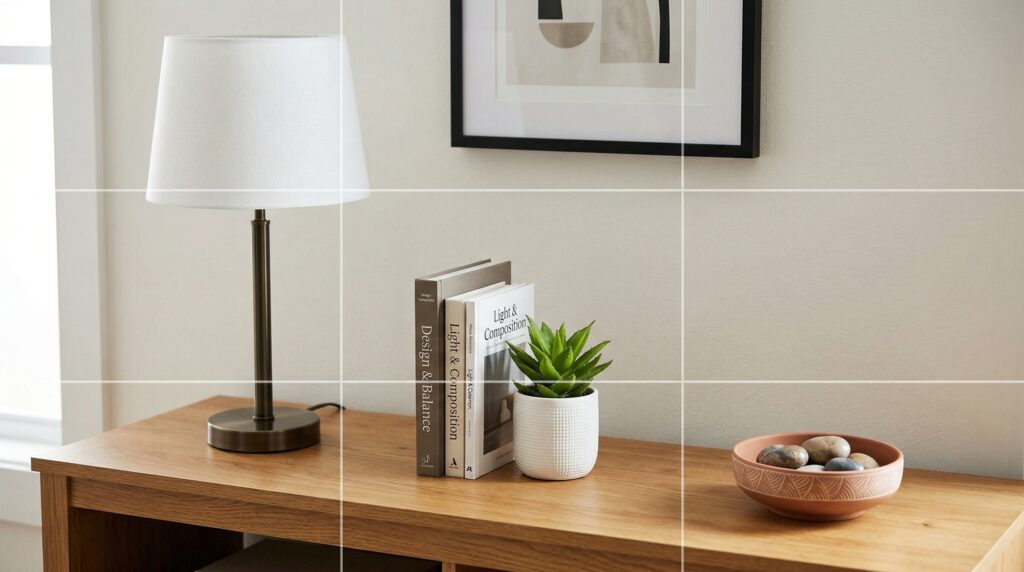
The golden rule of console table styling: divide the surface into three visual zones.
How it works:
- Left third: Tall object (lamp, tall vase, or sculpture)
- Middle third: Medium-height objects (books, small plant, decorative box)
- Right third: Low object (bowl, tray, or short plant)
Why this works:
The varied heights create visual interest. Your eye moves across the table instead of landing on one flat plane. This is the same principle used in photography and art composition.
Pro tip: The tallest object should be roughly 1/3 the height of the wall space above the table. If you have 6 feet of wall space above the table, your tallest object should be around 24 inches.
LAYERING: CREATING DEPTH
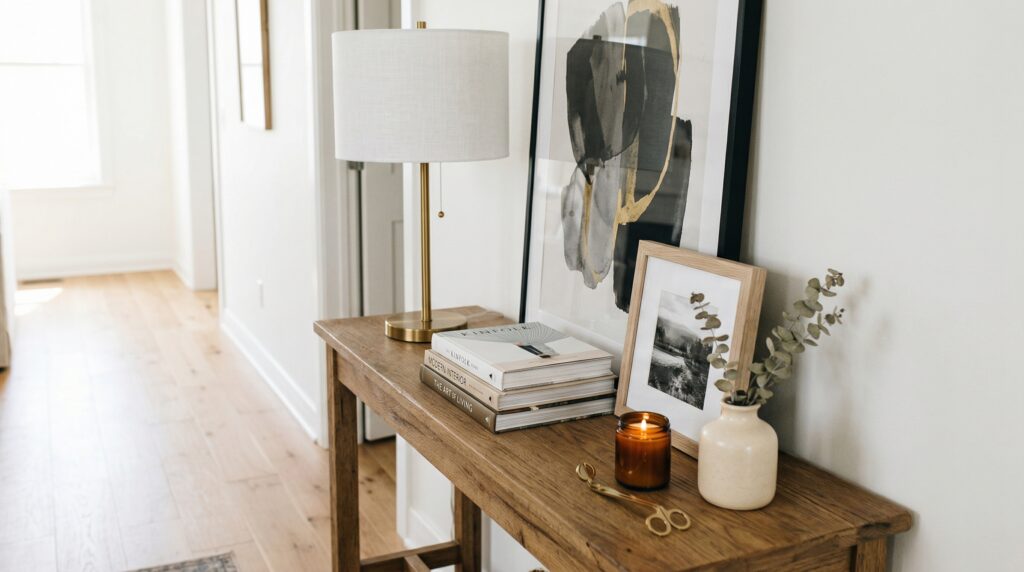
Flat styling looks amateur. Professional styling has depth.
The three layers:
- Back layer: Tall items that anchor the display
- Table lamp
- Large vase with branches
- Artwork leaning against the wall
- Mirror (if not hanging above)
- Middle layer: Medium-height objects
- Stack of 2-3 coffee table books
- Medium vase with flowers
- Picture frames
- Decorative boxes
- Front layer: Small, low objects
- Decorative tray with keys
- Small candles
- Low bowl
- Small plant
How to layer:
Place your tallest items toward the back, medium items in the middle, and smallest items toward the front. This creates a “staircase” effect when viewed from the side.
SYMMETRICAL VS. ASYMMETRICAL STYLING
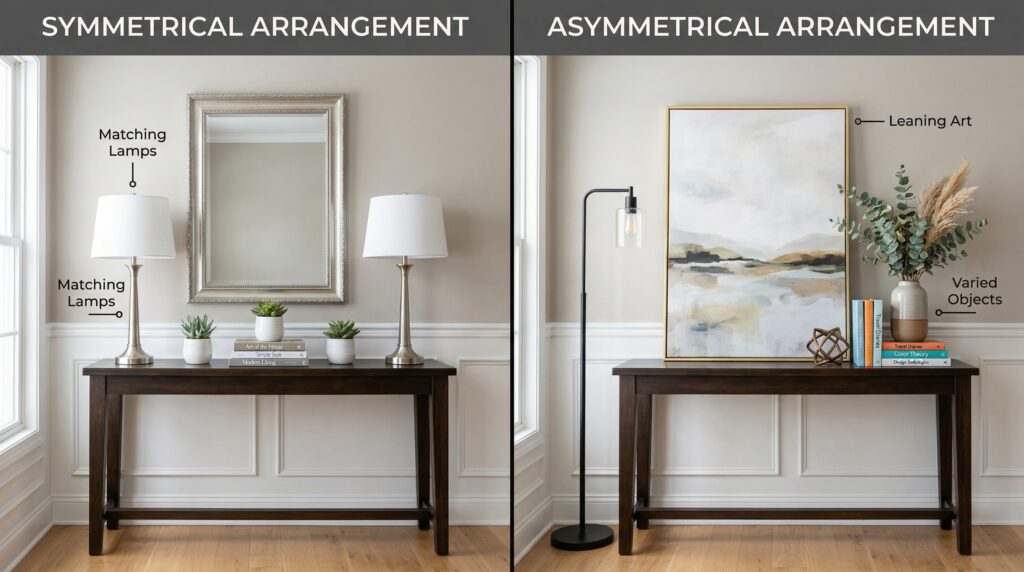
There are two approaches to console table styling — and both work.
Symmetrical Styling
Best for: Traditional, formal spaces
How to do it:
- Place matching lamps on both ends
- Center a mirror or artwork above
- Use identical or similar objects on each side
- Create a balanced, mirrored look
Example setup:
- Left: Table lamp + small plant
- Center: Decorative tray with candles
- Right: Matching table lamp + small plant
Asymmetrical Styling
Best for: Modern, eclectic spaces
How to do it:
- Place one tall object on one side (lamp or tall vase)
- Balance with multiple smaller objects on the other side
- Create visual weight without mirroring
Example setup:
- Left: Tall table lamp
- Center: Stack of books + small vase
- Right: Low bowl + small sculpture
Pro tip: Asymmetrical styling is harder to pull off but looks more collected and less staged. The key is balancing visual weight — one large object on one side should be balanced by multiple smaller objects on the other.
WHAT TO PUT ON A CONSOLE TABLE
Not sure what objects to use? Here’s a starter list.
Functional items:
- Table lamp (provides ambient lighting)
- Decorative tray (corrals keys, mail, sunglasses)
- Small bowl or dish (for loose change, jewelry)
Decorative items:
- Coffee table books (2-3 stacked)
- Vase with fresh or faux flowers
- Candles (varying heights)
- Small plant or succulent
- Decorative box
- Small sculpture or object
- Picture frame
Artwork above the table:
- Large mirror (makes the space feel bigger)
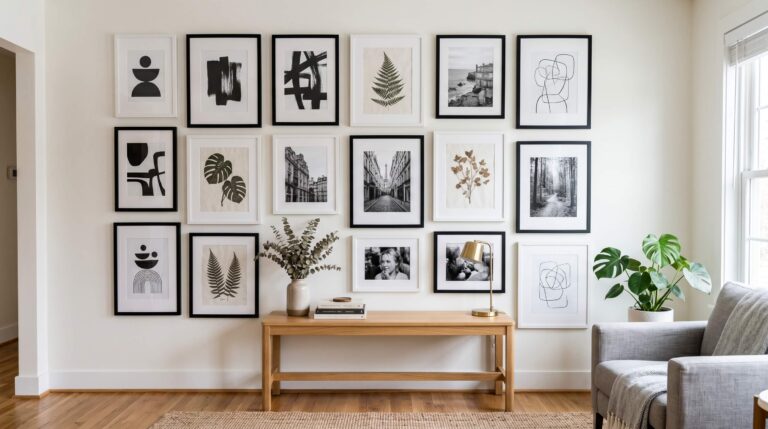
- Framed art (single large piece or gallery wall)
- Leaning artwork (casual, layered look)
STYLING FORMULAS THAT WORK
Here are three foolproof console table styling formulas.
Formula 1: Classic Symmetry
- Left: Table lamp
- Center: Tray with candles + small plant
- Right: Matching table lamp
- Above: Large mirror
Formula 2: Asymmetrical Balance
- Left: Tall vase with branches
- Center: Stack of 3 books + small vase with flowers
- Right: Low decorative bowl + small plant
- Above: Leaning artwork
Formula 3: Minimalist
- Left: Single table lamp
- Center: Small vase with single stem
- Right: Empty space
- Above: Single large framed print
COMMON STYLING MISTAKES
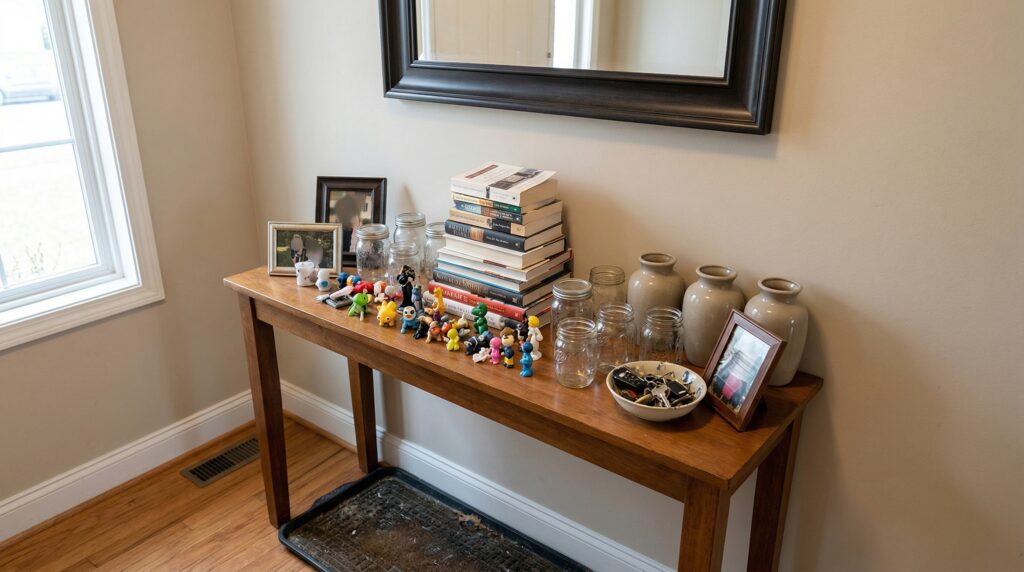
1. Everything is the same height
If all your objects are the same height, the display looks flat and boring. Vary the heights — aim for at least three different levels.
2. Objects are too small for the table
Tiny objects on a large console table look lost. Scale matters. If your table is 48 inches long, don’t use objects smaller than 6 inches.
3. Too much stuff
Overcrowding makes the table look cluttered and stressful. Leave some negative space. A good rule: fill 60-70% of the table surface, leaving 30-40% empty.
4. No lighting
A console table without a lamp feels incomplete — especially in an entryway. A table lamp adds warmth and function.
5. Ignoring the wall above
The console table and the wall above it should feel connected. If you have a large blank wall above the table, add a mirror, artwork, or leaning frames.
6. Forgetting about scale
The objects on your console table should relate to the size of the table and the wall. A tiny vase on a 60-inch console table looks silly. A massive lamp on a 30-inch table looks overwhelming.
STYLING BY ROOM
Console tables aren’t just for entryways. Here’s how to style them in different spaces.
Entryway Console Table
Function: Drop zone for keys, mail, bags
Styling:
- Table lamp for ambient lighting
- Decorative tray for keys and sunglasses
- Small bowl for loose change
- Fresh flowers or plant
- Mirror above to check yourself before leaving
Living Room Console Table (Behind Sofa)
Function: Visual anchor, display space
Styling:
- Two matching lamps for reading light
- Decorative objects (vases, sculptures, books)
- Taller objects work here since you’re viewing from a seated position
- Artwork or mirror above
Hallway Console Table
Function: Display and storage
Styling:
- Keep it minimal (hallways are narrow)
- One lamp + one or two small objects
- Use baskets underneath for hidden storage
- Avoid anything that sticks out too far
SEASONAL STYLING
Change your console table styling with the seasons to keep it fresh.
Spring:
- Fresh tulips or daffodils
- Light, bright colors
- Pastel candles
- Botanical prints
Summer:
- Greenery and ferns
- Coastal elements (shells, driftwood)
- Light, airy vibe
- Neutral tones
Fall:
- Pumpkins and gourds
- Warm tones (orange, rust, gold)
- Dried flowers or wheat
- Cozy candles
Winter:
- Evergreen branches
- Candles and warm lighting
- Metallic accents (gold, silver)
- Cozy textures
QUICK REFERENCE GUIDE
For traditional spaces:
- Symmetrical styling
- Matching lamps on both ends
- Classic decorative objects (silver trays, crystal vases)
- Large mirror above
For modern spaces:
- Asymmetrical styling
- One statement lamp
- Minimal objects with clean lines
- Abstract art above
For eclectic spaces:
- Mix of symmetrical and asymmetrical
- Varied textures and materials
- Collected objects with personality
- Gallery wall or leaning art above
For small spaces:
- Keep it minimal (3-5 objects max)
- Use a mirror above to make space feel larger
- Choose multi-functional objects (lamp + storage)
- Avoid anything too deep or wide
WHERE TO SHOP
Budget-friendly:
- IKEA (Liatorp and Hemnes console tables)
- Target (Threshold decor)
- HomeGoods (unique finds)
Mid-range:
- West Elm
- CB2
- Article
- Pottery Barn
High-end:
- Room & Board
- Serena & Lily
- Restoration Hardware
- One Kings Lane
Pro tip: Mix high and low. Invest in a quality console table and lamp, then fill in with budget-friendly decorative objects.
FINAL THOUGHTS
Styling a console table is about balance — not too much, not too little, and varied heights that create visual interest.
Start with the rule of thirds, add layers for depth, and don’t be afraid to edit. Remove one object at a time until the display feels right.
The best console tables look collected over time — not like everything was bought in one trip. Add personal touches (a favorite book, a travel souvenir, a family photo) to make it feel like yours.
And remember: styling is never permanent. Swap out objects, try new arrangements, and change things seasonally. That’s what makes it fun.