My Desk Used to Need Crime Scene Tape. Here’s the $17 Book That Finally Fixed It.
Affiliate Disclosure: This post contains affiliate links. If you make a purchase through my link, I may earn a small commission at no extra cost to you. I only recommend things I’ve genuinely found useful.
I couldn’t find my desk.
Not “my stuff was a little messy” — I mean the physical surface had ceased to exist as anything other than a concept. A flat plane that was, philosophically speaking, probably still there somewhere.
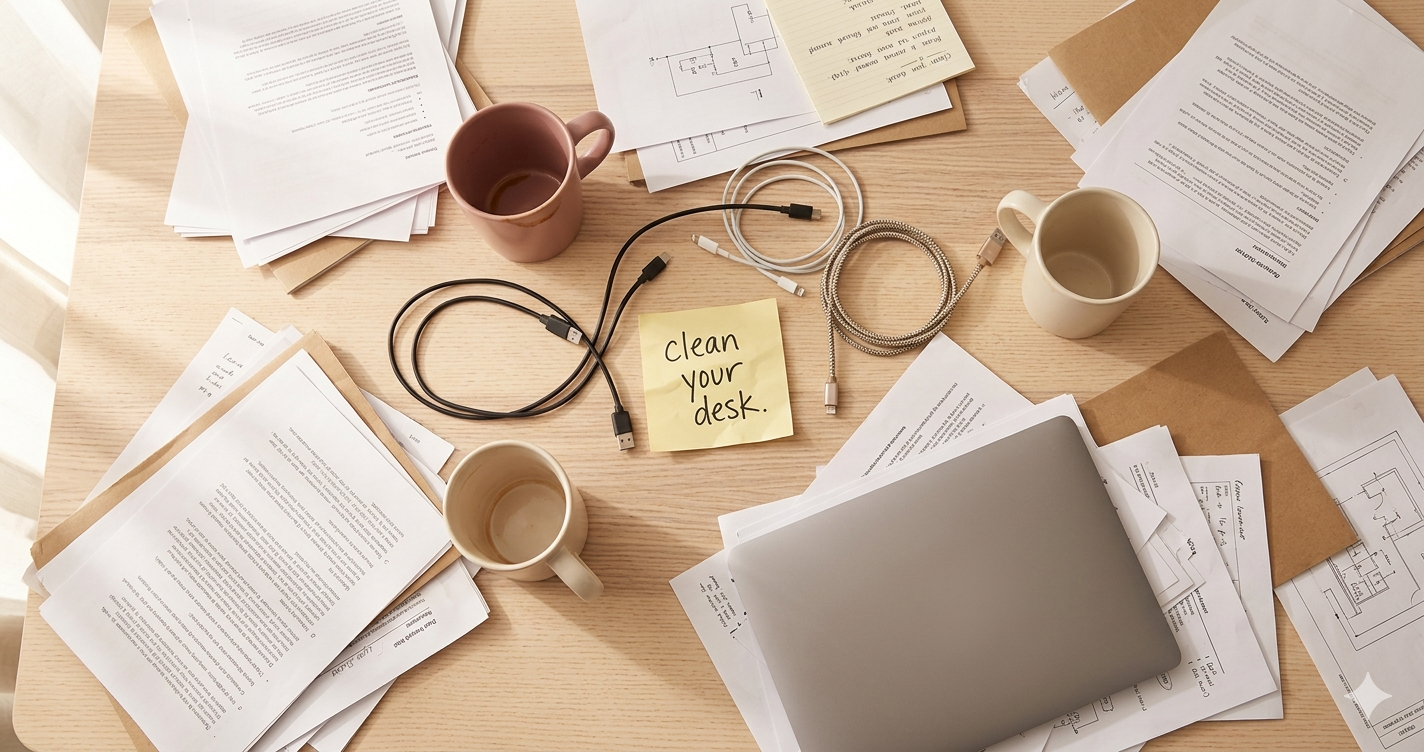
In practice, it was buried under:
– Documents I printed three months ago (“just in case”)
– Four charging cables for devices I no longer own
– Two coffee mugs I was *definitely* going to wash later
– A sticky note that said “clean your desk”
That last one gets me every time.
Every morning I’d sit down, open my laptop, and my first thought wasn’t *let’s have a productive day*. It was *where did all of this come from and why does it feel like it’s watching me*.
You know that feeling — sitting in front of a pile of things, a hundred tasks on your mind, and somehow none of them feel possible to start?
That’s not laziness. That’s your environment quietly draining your energy before your day even begins.
Why You Declutter — And Then End Up Right Back Here
I’d tried everything. A short tour:
**Attempt #1: Buy organizers first.**
I spent $40 on a “minimalist Nordic-style organization system.” What I accomplished: I took all my random, disorganized junk and stored it neatly inside labeled boxes. Nothing actually changed. It just looked better while staying exactly as useless. Organized chaos is still chaos.
**Attempt #2: The Saturday Cleaning Plan.**
Every Friday I told myself, *tomorrow, for real this time*. Every Saturday I woke up feeling motivated, spent two hours on my phone, and quietly rescheduled the plan to next weekend. That Saturday still hasn’t arrived.
**Attempt #3: The “Creative Chaos” Reframe.**
I convinced myself that brilliant people have messy desks. Steve Jobs. Einstein. Visionaries don’t need order. This worked great — until I realized those people had entire teams helping them find their things. I do not have a team. I have a sticky note.
The problem wasn’t discipline. The problem was that I never had a system that actually worked *for me*.
—
The One Sentence That Made Me Stand Up and Start Throwing Things Away
I’d cleared my desk dozens of times. Cleared it and watched it fill right back up, like the universe was personally offended by empty surfaces.
Then I came across a line that stopped me completely:
> **Your problem isn’t that you have too much stuff. It’s that you haven’t decided which things don’t belong in your life.**
I sat with that for a full three minutes.
Then I picked up the three-hole punch on the corner of my desk — the one that had been sitting there for two years, used exactly once — and dropped it in the trash bag without a second thought.
That was when I understood: I’d been *organizing* my whole life. But I had never actually *decided*.
—
The Book

That shift came from a small ebook called Declutter Fast by Mimi Tanner.
I know what you’re thinking. *Another decluttering book. More advice about folding things vertically.*
That’s exactly what I thought. Until I opened the first chapter and didn’t look up until I’d filled three trash bags.
Not because it was motivational in a cheerleader-pep-talk way. Because it gave me a **decision-making framework** that actually clicked — the kind where something locks into place in your mind and you can’t un-hear it. For the first time, I could look at any object and know, immediately, whether it stays or goes.
Declutter Fast has been the top-ranked book in its category on ClickBank for years. Not because of a massive ad budget. Because people who buy it come back and tell other people about it.
The price is $17.
Not a $97 online course. Not a $297 “complete transformation system.” Seventeen dollars — roughly what you’d spend on takeout — for a way of thinking you’ll use for the rest of your life.
[See what’s inside Declutter Fast →]
—
One Thing I’ll Tell You for Free
The book has a complete system, and I’m not going to walk you through all of it here — that’s what you’re spending the $17 for.
But one thing I’ll share:
The reason decluttering fails almost every time isn’t that you don’t have enough time. It’s that you’re making decisions and moving things simultaneously — and that double load is exhausting. So you stop.
The fix is to separate those two things. Spend 20 minutes doing *only one thing*: deciding what goes. Don’t touch anything yet. Just decide.
Once that’s done, the physical part becomes almost effortless.
That single change let me finally clear my space — without the familiar crash-and-give-up that had ended every other attempt before it.
Everything else is in the book.
—
Three Mistakes I Made (That You Don’t Have To)
Mistake #1: Shopping for storage before deciding what to keep.
Wrong order, every time. If you don’t know what’s staying, you can’t know what size bins or how much storage you need. Clear first. Shop after.
Mistake #2: “I’ll just put it here for now” is not a strategy.
“For now” is a black hole. Things that go there do not come back out. Every object on your desk should have one answer to the question: *why is this here?* If you can’t answer that, it doesn’t belong there.
Mistake #3: Ignoring the places you can’t see.
The cable jungle behind your monitor. The forgotten back corner of the bottom drawer. Out of sight doesn’t mean out of mind — your brain is quietly tracking all of it, running a background process you never asked for, burning energy you could be using on actual work.
—
One Thing to Try Right Now
I’m not going to give you a ten-step action plan. You’ll read it, save it somewhere, and nothing will change.
Here’s the one thing I’d suggest instead:
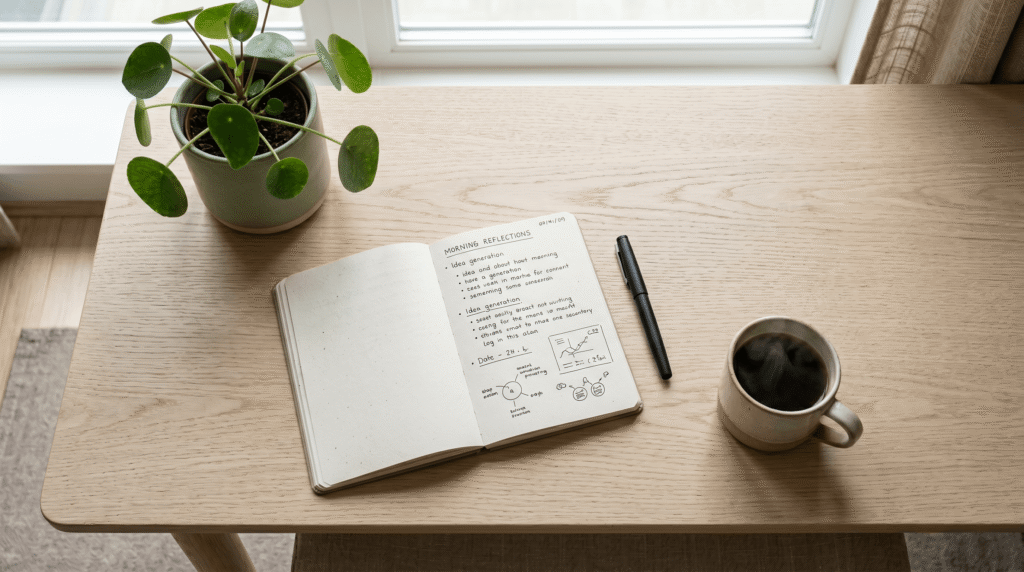
Right now, take everything on your desk that falls into the “might be useful someday” category and put it in a cardboard box. Don’t throw it away — just box it up and move it out of sight.
Keep only what you know for certain you’ll use today.
Tomorrow, look at the box. Notice whether you touched a single thing in it.
Then you’ll understand what I mean.
If you want the complete decision-making system — the one that walks you through exactly how to evaluate every type of object in your space, and how to keep it clear so it doesn’t slowly come back —
A desk where you can sit down and actually *start working* — instead of spending the first twenty minutes excavating your laptop — is worth more than that.
—
*Affiliate Disclosure: This post contains affiliate links. If you click and make a purchase, I may earn a small commission at no extra cost to you. I only recommend products I’ve personally used and found genuinely useful.*